
Ambi Robotics is building AmbiSort systems into parcel sortation cells
AmbiSort A-Series, AmbiSort B-Series, AmbiOS, and Pitney Bowes customer language give Ambi Robotics a parcel-sortation automation layer.
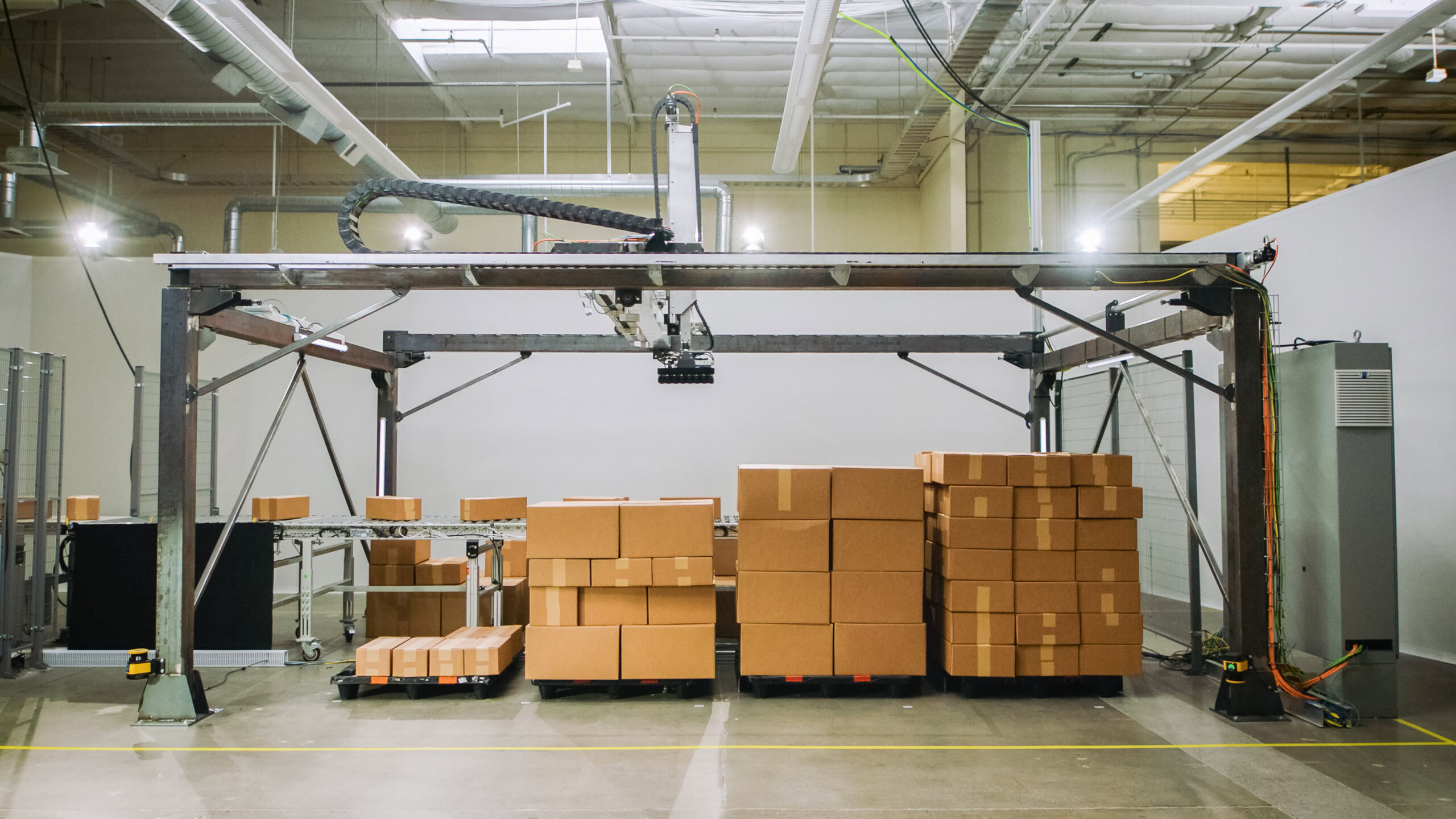
Ambi Robotics is building parcel sortation around AmbiSort A-Series and B-Series, with A-Series aimed at sort-to-sack workflows and B-Series aimed at sort-to-Gaylord containerization. That product split puts Ambi in the parcel operations layer where packages vary by size, weight, baggability, label position, and destination rules.
AmbiStack handles stack-to-anything workflows, while AmbiOS classifies parcels and assigns sort destinations across Ambi systems. Parcel automation is not only a picking problem; it is a constant routing problem where the robot has to connect perception, grasping, placement, and the facility?s sort logic.
Pitney Bowes gives Ambi a named customer signal. Ambi quotes Pitney Bowes CEO Marc Lautenbach in customer material, confirming a relationship around logistics automation even though the public material does not disclose facility count or deployed robot count. Ambi also claims a 400 percent increase in associate throughput and more than 99 percent sort accuracy, figures that create a useful operating signal but are not broken out by customer site.
Ambi?s origin sits in Berkeley robotic manipulation research. The company was founded by Jeff Mahler and Ken Goldberg, and its public story grew out of the Dex-Net research line on robot grasping, synthetic data, and ambidextrous manipulation. That background fits the parcel problem: the hard part is not only moving quickly, but choosing reliable grasps and placements across messy, non-identical packages.
The competitive field includes Berkshire Grey, RightHand Robotics, Dexterity, Plus One Robotics, Mujin, XYZ Robotics, Pickle Robot, and traditional parcel sortation integrators. Ambi?s distinction is the combination of parcel-specific robot cells and AmbiOS software around classification and destination assignment, rather than treating the arm as a standalone piece of automation.
The proof boundary is still customer-level visibility. Public material covers AmbiSort A-Series, AmbiSort B-Series, AmbiStack, AmbiOS, Pitney Bowes customer language, a 400 percent associate-throughput claim, and more than 99 percent sort accuracy. It does not show robot count by facility, parcels sorted per robot hour, intervention frequency, parcel damage rate, renewal terms, service response time, unit pricing, or throughput by product line.
Ambi?s strategic test is whether parcel sorting can become a software-coordinated manipulation layer rather than a custom integration project at every site. If AmbiOS keeps connecting perception, grasping, and destination logic across live parcel operations, Ambi can sell more than robot cells: it can sell a repeatable operating layer for high-variance sortation.
Have a robotics update Korthos should review? Send news, deployments, product releases, funding rounds, research, or media to tips@korthos.xyz or reach out on X at @agkorthos.