
Chef Robotics is turning food assembly robots into a production data layer

A 100 million serving production milestone, NSF-certified portioning module, and 43.1 million dollar Series A give Chef Robotics a live factory data base for high-variance food handling.
Published: 2026-04-17

Type: ARTICLE

Tags: Chefos, Food Manufacturing, Food Robotics, Meal Assembly, Physical Ai, Robotics As A Service

Canonical Korthos article

Chef Robotics is turning food assembly robots into a production data layer

A 100 million serving production milestone, NSF-certified portioning module, and 43.1 million dollar Series A give Chef Robotics a live factory data base for high-variance food handling.

Chef Robotics reached 100 million completed servings in production on April 17, 2026 across more than a dozen production facilities in the United States, Canada, and Europe. The milestone shows a production curve: one million servings in April 2023, 10 million in January 2024, 50 million in May 2025, and 100 million less than a year later.

Chef raised $43.1 million in Series A financing in March 2025, including $20.6 million in equity and $22.5 million in equipment financing debt. Avataar Ventures led the equity round, bringing total capital raised to $65.6 million. The debt layer fits the company's Robotics-as-a-Service model, where food manufacturers lease robots instead of buying large capital equipment upfront.

Founder and CEO Rajat Bhageria built Chef around food assembly, a deceptively hard manipulation surface. Prepared-food lines handle wet ingredients, sticky foods, leafy greens, portion variation, sanitation rules, and line-speed pressure. A robot has to work next to people, maintain food safety, and adapt to natural ingredient variation without turning every recipe into a custom automation project.

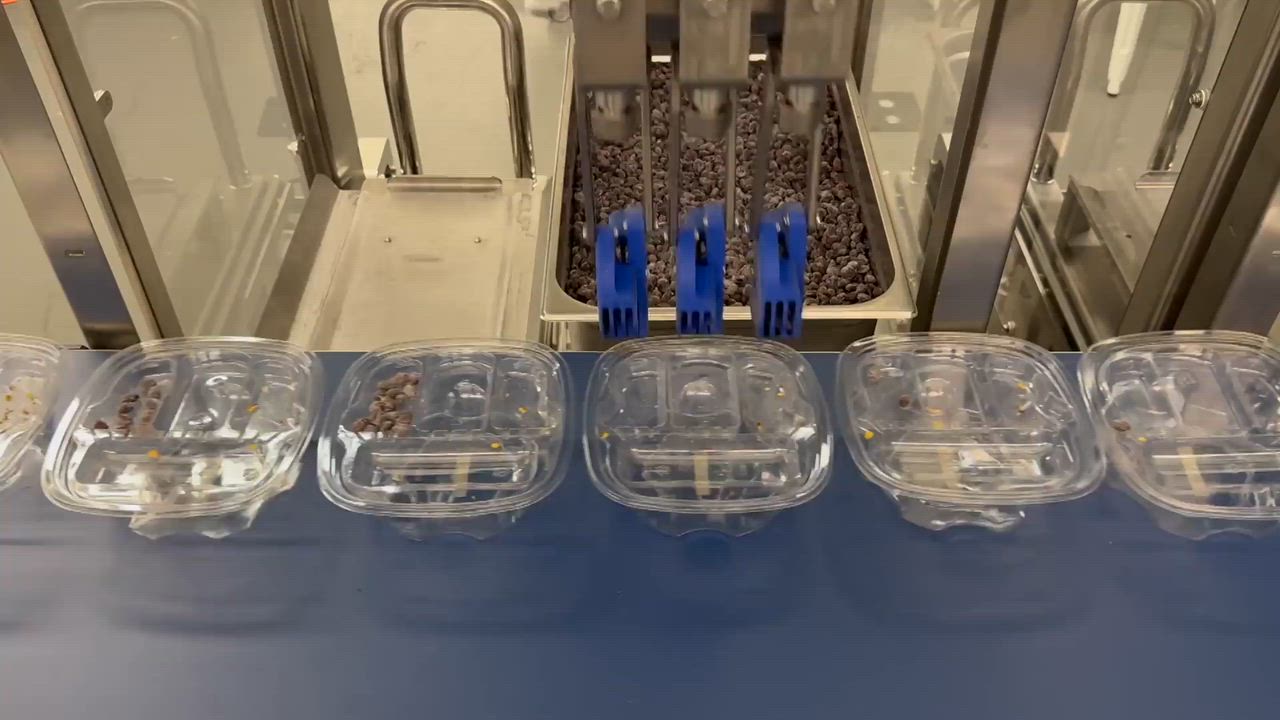
Chef's robotic module C-001748 received NSF certification in June 2025 under NSF/ANSI 169 for special-purpose food equipment and devices. The certified system works alongside production-line staff, picking ingredients from conveyors into meal trays. Chef later added piece-picking for individual food items from unstructured totes using RGBD camera data, segmentation models, and a food-safe vacuum utensil based on the venturi effect.

ChefOS is the software layer across the deployments, trained on production variability from foods such as mixed vegetables, pulled meat, and leafy greens. The Series A release named Amy's Kitchen, Sunbasket, and Chef Bombay as production customers, giving the 100-million-serving claim a customer context rather than a lab benchmark.

The competitive field includes Miso Robotics, ANIAI, Picnic, food portioning equipment suppliers, manual assembly lines, and custom automation integrators. Chef's distinction is production serving volume tied to flexible ingredient handling and a RaaS model. Public material does not show robot count by facility, servings by customer, site-level uptime, intervention frequency, SKU changeover time, sanitation cycle duration, or yield data by ingredient. If Chef keeps converting food-line edge cases into better manipulation performance, it becomes a production data layer for prepared-food automation rather than a single-purpose meal assembly robot.

Have a robotics update Korthos should review? Send news, deployments, product releases, funding rounds, research, or media to tips@korthos.xyz or reach out on X at @agkorthos.

Referenced on Korthos

Track the machine economy

Regular Korthos briefings on robotics, drones, physical AI, supply chains, funding, product launches, and the companies shaping the stack.