
Dexterity is turning production actions into container-loading capital
Dexterity raised $95 million at a $1.65 billion valuation in 2025 while pointing to FedEx, UPS, and a growing record of autonomous production actions.
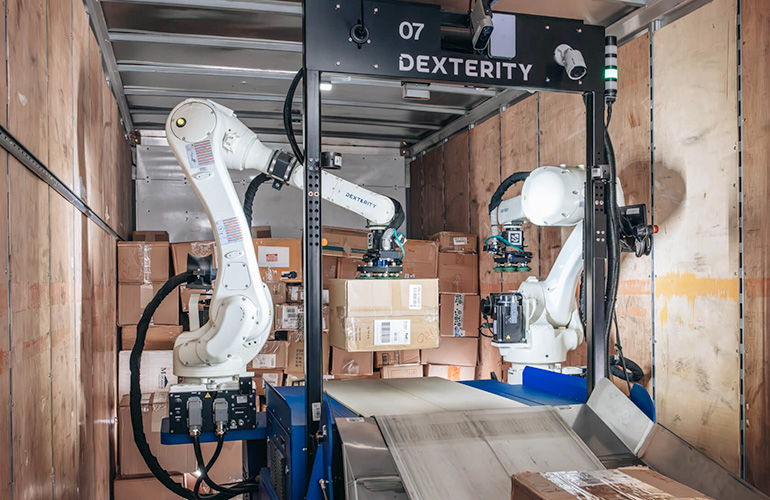
Dexterity raised $95 million in 2025 at a $1.65 billion post-money valuation, with TechCrunch citing customers including FedEx and UPS. The company had raised nearly $300 million altogether, giving its box-handling robots a late-stage capital base tied to logistics work rather than a humanoid form-factor race.
The operating record is the useful counterweight. Dexterity says it surpassed 10 million autonomous in-production actions in 2023 and reached 100 million autonomous actions by 2025. Those are aggregate company claims, but they are still more concrete than a single demo: the company is framing autonomy around repeated production actions in customer environments.
Dexterity was founded by CEO Samir Menon, whose Stanford PhD work focused on robotic control and simulation. TechCrunch reported that the company uses specialized AI models, each focused on a specific task, for work such as loading boxes and sorting parcels. That task-specific approach fits logistics: box handling rewards reach, grasp reliability, packaging tolerance, and dock throughput more directly than human shape.
Robot Report described the 2025 raise as capital for container-loading robots and noted Dexterity's DexR work with FedEx, Sagawa Express, and GXO Logistics. Container loading is a harder surface than simple parcel transfer: the robot has to handle variable box sizes, wall-building patterns, shifting trailer geometry, package damage risk, and throughput expectations at the dock.
The competitive field includes Boston Dynamics Stretch, Pickle Robot, Mujin truck-loading systems, Berkshire Grey/FedEx parcel automation, Plus One-style supervised parcel cells, and custom integrator-built loading systems. Dexterity's distinction is a broad manipulation stack with customer names and aggregate production-action history, not a single-purpose unloading machine.
The proof boundary is customer economics. Public sources show funding, customer names, task categories, and aggregate production actions, but they do not break those actions into sites, robot count, uptime, throughput per dock, intervention rate, or renewal behavior. Dexterity's strategic bet is that production actions become the unit of value in logistics robotics: if robots can keep accumulating reliable box-handling work, the company can sell automation as operational capacity rather than hardware novelty.
Have a robotics update Korthos should review? Send news, deployments, product releases, funding rounds, research, or media to tips@korthos.xyz or reach out on X at @agkorthos.