
Dexterous Hands Are Becoming a Market of Their Own
Shipments, production capacity and funding are accelerating as dexterous hands shift from bespoke robot components into a strategic hardware layer for physical AI.
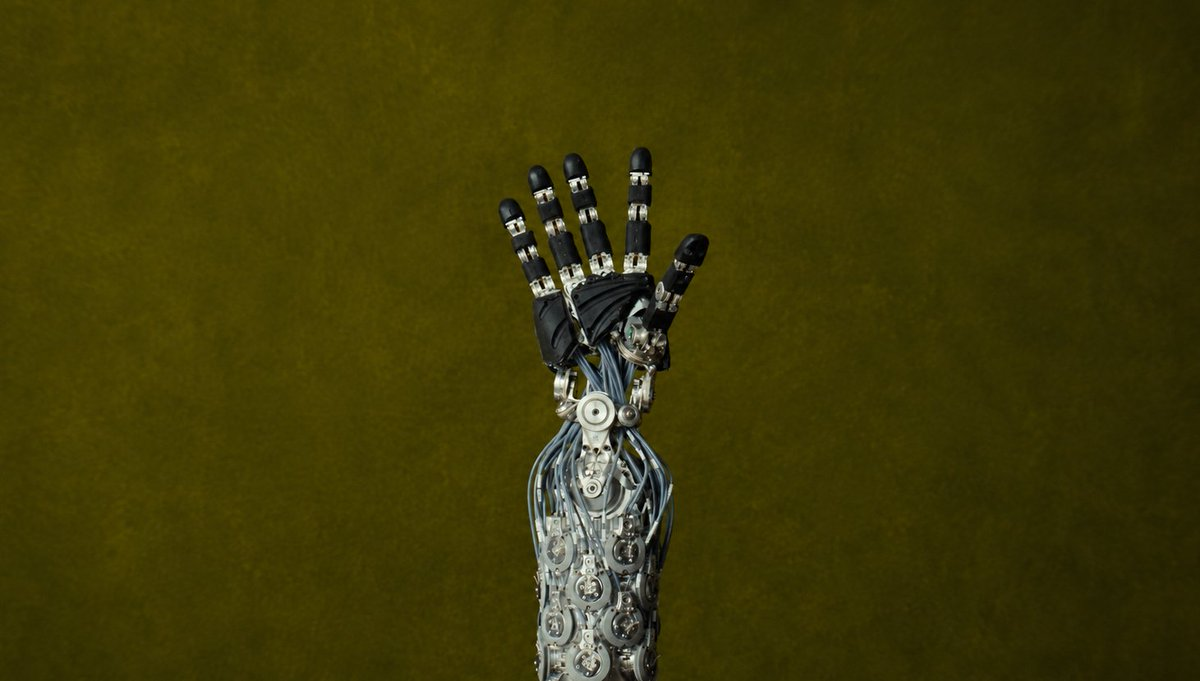
The reveal of 1X's latest NEO hand came with a manufacturing claim that would have sounded unusually large only a year ago. Days later, LinkerBot disclosed a new precision-production line built to support output measured in thousands of hands per month.
The company says hundreds of the new hands have already come off a dedicated production line, with capacity to produce 10,000 during 2026. The 25-degree-of-freedom hand is built end-to-end by 1X, including its motors, tendon materials, electronics, polymers, skin and tactile-sensing stack.
For 1X, this is part of a vertically integrated humanoid strategy. The hand is designed around NEO and the data generated through its use, rather than being presented primarily as a component for other robot makers. 1X frames the hand as an 'API to the physical world,' but hasn't formally announced standalone sales.
Dexterous hands are beginning to enter the same manufacturing ramp as humanoids themselves. Specialist suppliers are reporting annual deliveries, cumulative shipments and production capacity in the thousands or tens of thousands. Capital is following, with several Chinese hand companies raising substantial rounds or reaching multibillion-dollar valuations.
Production is moving beyond small batches
GGII estimates that approximately 19,200 dexterous hands were sold in China during 2025. It expects that figure to rise to around 70,200 in 2026 and exceed 430,000 by 2030. GGII also estimates that dexterous hands can represent 15% to 25% of a humanoid's bill of materials, potentially rising above 30% for higher-degree-of-freedom designs.
These are industry estimates rather than official statistics, and the public methodology does not make every product definition clear. But the direction is supported by the production claims emerging from individual suppliers.
Inspire Robots says it delivered more than 10,000 dexterous hands during 2025, approximately five times its 2024 volume. It has reportedly targeted 30,000 to 50,000 deliveries in 2026, supported by an expansion of its manufacturing footprint. The company also completed C1 and C2 financing rounds worth several hundred million yuan earlier this year.
LinkerBot reached its 10,000th cumulative hand shipment in December 2025.
LinkerBot has now established a wholly owned Beijing subsidiary, Lingdong Zhixin, and built an intelligent production line at the Beijing Robot Industrial Park in Changping. The company says the line has annual capacity for 60,000 to 100,000 dexterous hands.
The facility combines more than 140 high-precision CNC machines with an automated assembly line that uses LinkerBot’s own robotic arms and dexterous hands for some component-assembly work. LinkerBot has also demonstrated its own dexterous hands assembling hand joints and core components, an early example of the product being used inside its own manufacturing process. Small-batch production is expected to begin shortly.
The capacity range aligns with LinkerBot’s earlier disclosure that it was producing nearly 5,000 hands per month and planned to double output.
AGILINK says it has delivered more than 8,000 OmniHand dexterous hands and shipped over 10,000 grippers. Its latest financing raised nearly RMB 1 billion, pushing its post-money valuation above US$1 billion. The company said the proceeds would support manufacturing scale, manipulation data and the development of its contact-intelligence models.
Xynova is building a 5,400-square-metre facility intended to provide annual capacity for 10,000 dexterous hands and 200,000 miniature electric cylinders by the end of 2026. It has also raised hundreds of millions of yuan in Series A financing.
These figures should not be added together as though they measure the same thing. Inspire's number represents annual deliveries. LinkerBot's 10,000-unit milestone was cumulative. The later 5,000-unit monthly figure represents a current production rate. Xynova's number is planned capacity rather than completed shipments.
The step change is clear. Dexterous hands are no longer being manufactured only in research quantities. Suppliers are now investing in dedicated factories, precision component production and, in LinkerBot’s case, early use of the hands within the manufacturing process itself.
Capital is concentrating around the hand
LinkerBot is the clearest example of investor expectations moving ahead of the current market.
The company closed a Series B+ at a reported US$3 billion valuation and said it would seek as much as US$6 billion in its next financing. Reuters described LinkerBot as the global leader in highly dexterous hands for humanoids. The company claims more than 80% of the global market for high-degree-of-freedom robotic hands, although that figure appears to describe a narrowly defined segment and is difficult to verify independently.
The valuation is notable because LinkerBot is not trying to build the entire humanoid.
Its bet is that focusing on the hand provides exposure to many robot manufacturers without competing directly with complete-platform companies. If humanoid architectures remain fragmented, a successful component supplier can potentially sell across several competing systems.
AGILINK’s rapid rise to a valuation above US$1 billion suggests investors see a similar opportunity. The company emerged from AgiBot’s dexterous-hand operation and is now building around both hardware shipments and manipulation data. Inspire's repeated financing and factory expansion, and Xynova's backing from investors connected to Xiaomi and Li Auto, point toward the same conclusion.
Capital is not only funding complete humanoids but also moving into the suppliers that could control the most technically difficult and economically valuable subsystems.
Why the hand can become a strategic layer
A capable dexterous hand combines several difficult technologies in a very small volume.
It requires compact actuation, transmissions or tendons, force control, tactile sensing, compliant materials, durable joints, low weight and software capable of coordinating many degrees of freedom. The design also has to survive repeated contact with an unpredictable physical environment.
This makes the hand important beyond its share of hardware cost.
It is the point where a robot's intelligence becomes useful work. Mobility can bring a humanoid to a task, but manipulation determines whether it can handle tools, sort objects, connect cables or operate equipment.
The hand is also becoming part of the physical-AI data stack. Teleoperated hands can capture demonstrations of human manipulation, while tactile sensors generate information that vision alone cannot provide. Suppliers that place large numbers of similar hands across research laboratories and robot platforms may gain access to valuable and increasingly standardised manipulation data.
That helps explain why companies are investing not just in production lines, but also in teleoperation systems, datasets and manipulation models.
Different models are emerging
The market is split between vertically integrated robot makers and specialist suppliers.
Companies such as 1X, Figure and Tesla are developing hands as part of the complete humanoid platform, tightly linking hardware, sensing, control and data collection.
Specialists such as Inspire, LinkerBot, AGILINK and Xynova are taking the merchant-supplier route, aiming to sell across multiple humanoids, arms and research systems.
That model is not unique to China. Shadow Robot in the UK, qbrobotics in Italy, PSYONIC in the US and Singapore-based Sharpa also supply dexterous hands into research, teleoperation, prosthetics and robotics.
The difference is mainly in disclosure. Chinese suppliers are publishing shipment and capacity figures at much greater scale, while non-Chinese companies tend to disclose products, integrations and research users rather than factory output.
The two models can overlap. An integrated robot maker may eventually sell its hand externally, while a specialist supplier can become deeply embedded in a major platform.
Demand also extends beyond humanoids, including standalone arms, teleoperation rigs, industrial systems and research platforms.
Have a robotics update Korthos should review? Send news, deployments, product releases, funding rounds, research, or media to tips@korthos.xyz or reach out on X at @agkorthos.