Seegrid is building Palion AMRs into autonomous pallet movement
Seegrid tied its Palion AMR line to a May 2026 fleet milestone: 20 million autonomous miles, 2,500-plus deployed vehicles, and 200-plus customer sites.
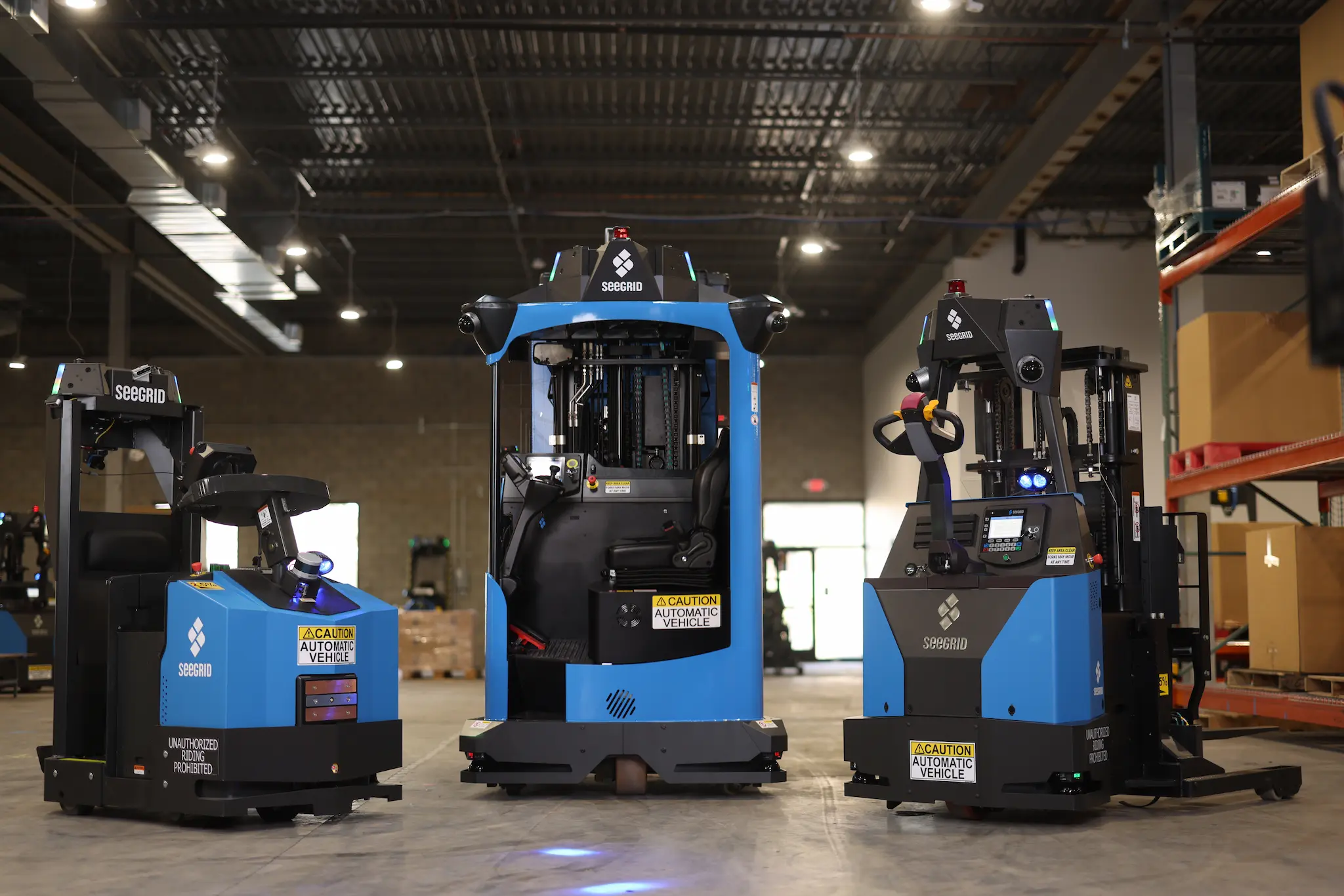
Seegrid crossed 20 million autonomous miles in May 2026, putting fleet-scale evidence ahead of the Palion product sheet. The company says those miles came from live production environments across more than 2,500 vehicles and more than 200 customer sites, with AMRs operating around people, forklifts, conveyors, route changes, and production schedules inside active facilities.
The Pittsburgh company was founded in 2003 by roboticist Hans Moravec, whose work at Stanford and Carnegie Mellon centered on robot perception and navigation. Seegrid says it commercialized Grid Engine technology in 2005, bringing 3D occupancy-grid mapping into industrial autonomy years before the current AMR investment cycle.
The Palion line divides pallet movement by job. Lift RS1 handles low-lift transport up to 6 feet and 3,500 pounds, Lift CR1 reaches 15 feet and 4,000 pounds, and Tow Tractor S7 covers longer-distance tugging where fork handling is the wrong tool. The product split matches facilities where one transport problem becomes several workflows once pallets move between production, storage, staging, and shipping.
Fleet Central gives Seegrid the software surface around those vehicles. The company positions the platform as enterprise fleet-management software for connected autonomy, with U.S.-based engineering, assembly, deployment, and support behind the robots. Route changes, operator acceptance, and safety discipline become service problems as much as autonomy problems once AMRs spread across hundreds of customer sites.
The competitive field includes MiR, OTTO Motors, Locus Robotics, Vecna Robotics, ForwardX, Balyo, AGILOX, and traditional forklift automation programs. Seegrid?s distinction is its long industrial navigation record and pallet-specific installed base: the company is not trying to prove that AMRs can move in a warehouse, but whether Palion can keep expanding into higher-reach, tugging, and enterprise fleet orchestration work.
The May 2026 milestone also points toward Physical AI and VDA 5050 interoperability. VDA 5050 gives AMRs a standardized vehicle-to-fleet communication path for warehouses mixing robot fleets and control systems. Seegrid still publishes aggregate proof more than customer-level detail: uptime, intervention rate, robot count by site, and site-level ROI remain outside public material.
Seegrid?s strongest current claim is fleet maturity in palletized workflows. If Palion keeps turning autonomous miles into safer pallet moves, Seegrid becomes less of an AMR supplier and more of a material-flow control layer for facilities that want autonomous movement without rebuilding every warehouse process around one robot type.
Have a robotics update Korthos should review? Send news, deployments, product releases, funding rounds, research, or media to tips@korthos.xyz or reach out on X at @agkorthos.