
RightHand Robotics is building RightPick 4 into piece-picking cells
RightPick 4, a larger item range, and more than one petabyte of picking data give RightHand Robotics a piece-picking automation layer.
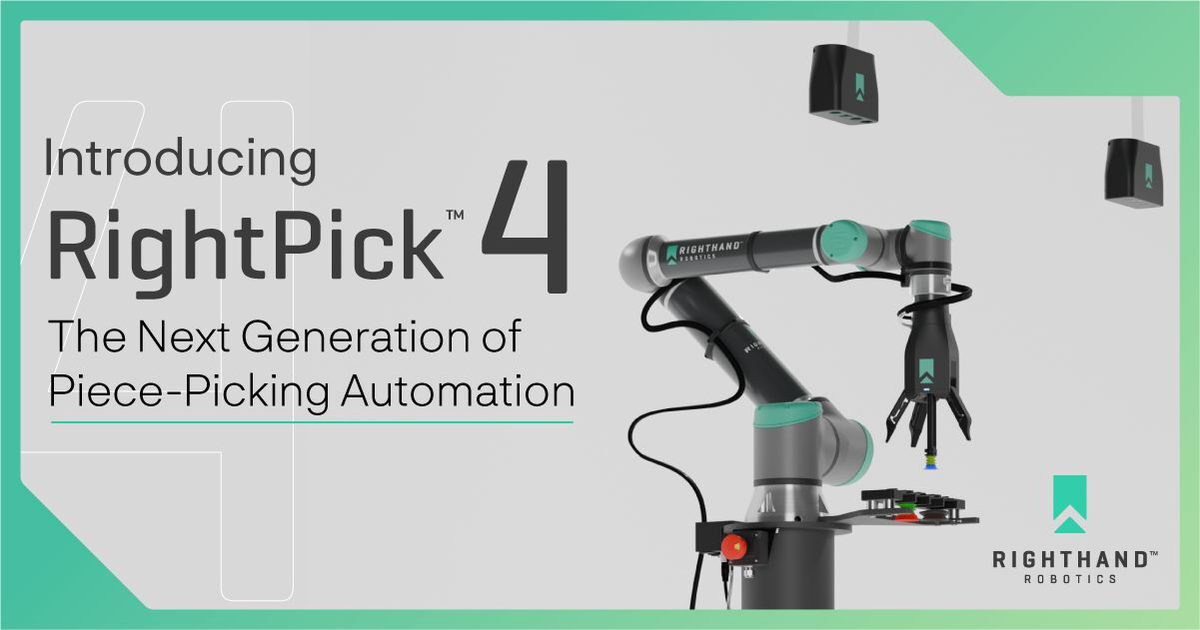
RightHand Robotics launched RightPick 4 on January 24, 2024, increasing the item range for robotic piece picking. The company says the system can handle items up to 25 percent larger and 50 percent heavier than the prior RightPick generation.
The product combines a three-finger suction gripper, industrial vision, and RightPick AI. Piece picking is not a single motion problem: the cell has to identify the item, choose a grasp, recover from failed picks, and place the product into the next container without damaging it or slowing the line.
RightHand says RightPick 4 was trained with more than one petabyte of operational data collected over eight years of picking tens of millions of items. That figure is aggregate fleet context rather than a customer-level average, but it supports the company?s argument that pick experience can compound across deployments.
RightHand was founded in 2015 by a DARPA challenge-winning team from the Harvard Biorobotics Lab, the Yale GRAB Lab, and MIT. Harvard material names Yaro Tenzer, Leif Jentoft, and Lael Odhner among the founders, connecting the company to academic work on compliant robotic hands and warehouse manipulation.
The competitive field includes Berkshire Grey, Ambi Robotics, Dexterity, Covariant-powered cells, Mujin, Plus One Robotics, Osaro, and traditional goods-to-person integrators adding robot arms at the workstation. RightHand?s distinction is the hand-and-learning stack: a gripper, vision, and AI system built around repeatable SKU variation instead of a generic arm dropped into a tote cell.
Public material does not show customer-level pick rate, SKU-class error rate, intervention frequency, deployment count by customer, uptime by cell, pricing, renewal rates, or service response time for RightPick 4. The proof is product-generation maturity and aggregate picking data rather than independently published customer metrics.
RightPick 4 tests whether operational data becomes a durable advantage in piece picking. If RightHand can turn years of pick experience into better performance on larger and heavier items, the company can position RightPick as a learned manipulation layer for fulfillment cells where SKU variation keeps defeating fixed automation.
Have a robotics update Korthos should review? Send news, deployments, product releases, funding rounds, research, or media to tips@korthos.xyz or reach out on X at @agkorthos.