
The Humanoid Bottleneck Is Leaving the Cage
NVIDIA's Halos launch puts safety infrastructure around physical AI deployment. Agility's Digit is the first humanoid in the system, and the reason why matters more than the platform itself.
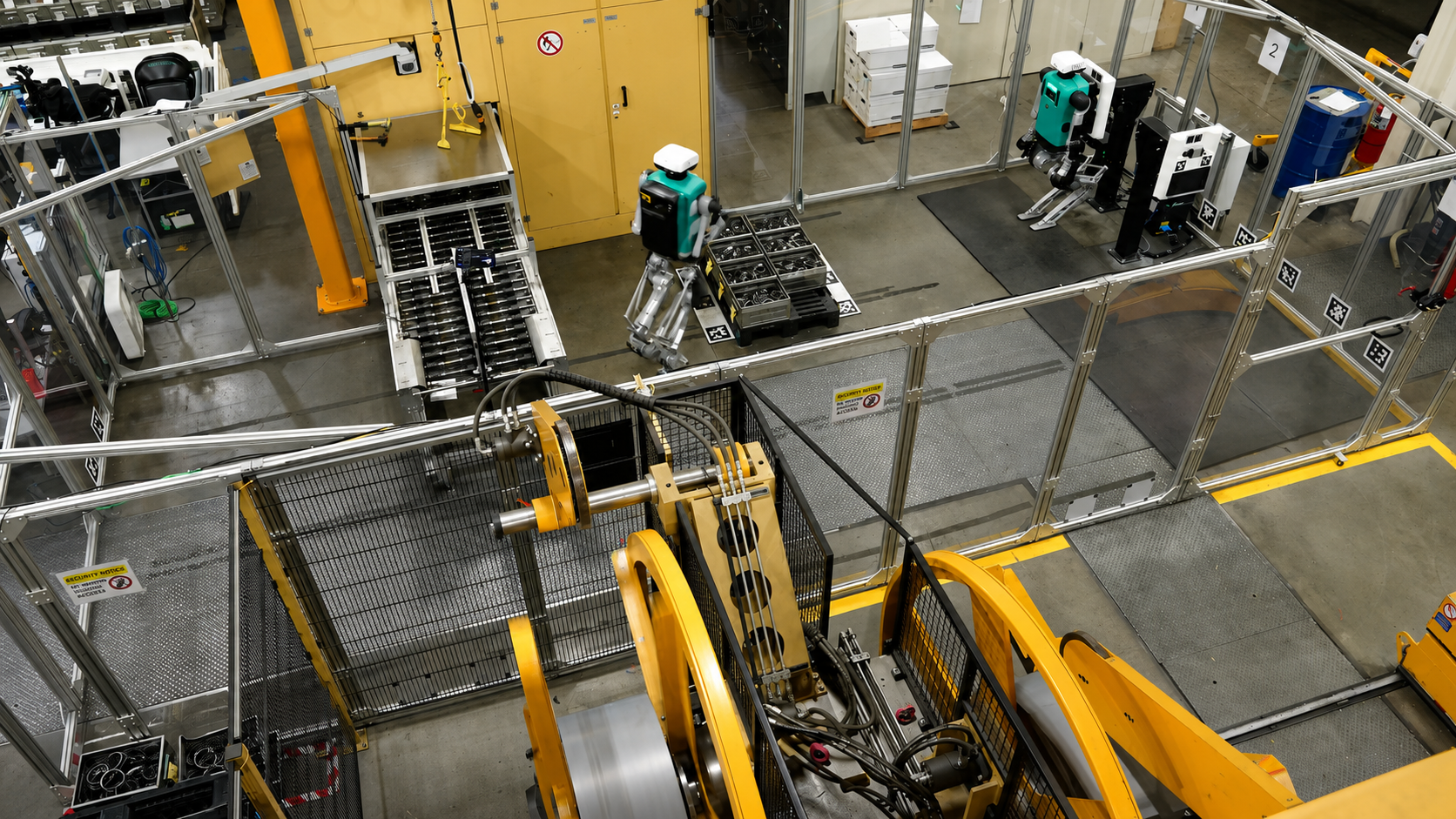
Today's most important humanoid announcement is not about walking, manipulation, or a new foundation model. It is about safety certification.
NVIDIA announced Halos for Robotics on June 22, extending its Halos safety framework from autonomous vehicles into robotics and physical AI. Agility is the first humanoid company to incorporate elements of it into Digit, its industrial humanoid with customer and deployment activity involving Amazon, GXO, Schaeffler, and Toyota Motor Manufacturing Canada. That pairing maps directly onto the problem Agility has been trying to solve in public: how to move Digit from controlled workcells into open environments where humans and robots share the same floor.
The cage problem
Industrial robots have traditionally been made safe by separation. Fenced cells, restricted zones, light curtains, and controlled access keep humans away from the robot's working envelope. The logic is simple: if the robot cannot reach a person, it cannot harm one.
Humanoids break that logic by design. Their value proposition is that they work in spaces built for people: warehouses, factories, loading docks, logistics operations, moving between tasks, navigating narrow aisles, and operating alongside workers. A humanoid that can only work inside a cage automates a station. One that can move safely through a facility automates a workflow.
The safety behavior she described is specific. If a human approaches the humanoid, the robot needs to take action to bring itself down to the ground, avoid harming the person, and avoid dropping whatever payload it is carrying.
Johnson also tied that transition directly to Agility’s product roadmap. She described the current Gen 4 robot as still operating around the safety-cage model, while the next Gen 5 architecture is expected to scale because it can operate outside the workcell, moving to areas such as loading docks and travelling among human workers.
Those details are interview-sourced, not formal certification claims. Agility has also said publicly that safety standards for dynamically stable industrial mobile robots are still developing.
What NVIDIA is doing
Halos for Robotics is positioned as a full-stack safety system spanning AI compute, sensor connectivity, system software, safety applications, and inspection support. The stack includes IGX Thor for industrial-grade AI compute with built-in safety capabilities, the Holoscan Sensor Bridge for sensor connectivity, Halos OS and Halos Core for safety-related operating functions, an Outside-In Safety Blueprint using external sensors, and the Halos AI Systems Inspection Lab. NVIDIA says the lab is the first program accredited by the ANSI National Accreditation Board for functional and AI safety assessment for physical AI, working with certification bodies including TUV Rheinland, UL Solutions, TUV SUD, exida, SGS, and CertX.
Agility is integrating IGX Thor and Halos Core into Digit's proprietary safe human detection system, with IGX Thor delivering industrial-grade AI compute and Halos Core supporting the software layer for safety-related operating functions. Together, Agility and NVIDIA plan to use the lab to help ensure Digit's safety-related software, AI components, and cybersecurity protections meet standards including IEC 61508, ISO 13849, and ISO/IEC TR 5469 before final third-party certification.
As Johnson said in NVIDIA's announcement: "For humanoids to deliver value at scale, safety has to be built into the robot and validated across the entire system."
Why this matters commercially
Agility has built RoboFab in Salem, Oregon, with stated capacity for more than 10,000 robots per year. Production capacity at that level only becomes relevant if the deployment constraints are solved. A robot that requires a controlled workcell at every customer site is a different commercial product from one that can move freely across a facility. The safety certification path is therefore not a compliance box.
Have a robotics update Korthos should review? Send news, deployments, product releases, funding rounds, research, or media to tips@korthos.xyz or reach out on X at @agkorthos.