
Addverb is turning wheeled humanoid hardware into an industrial mobility layer
Elixis-W extends Addverb from warehouse automation into wheeled humanoid robotics, where its installed automation base gives the company a clearer path to industrial pilots.
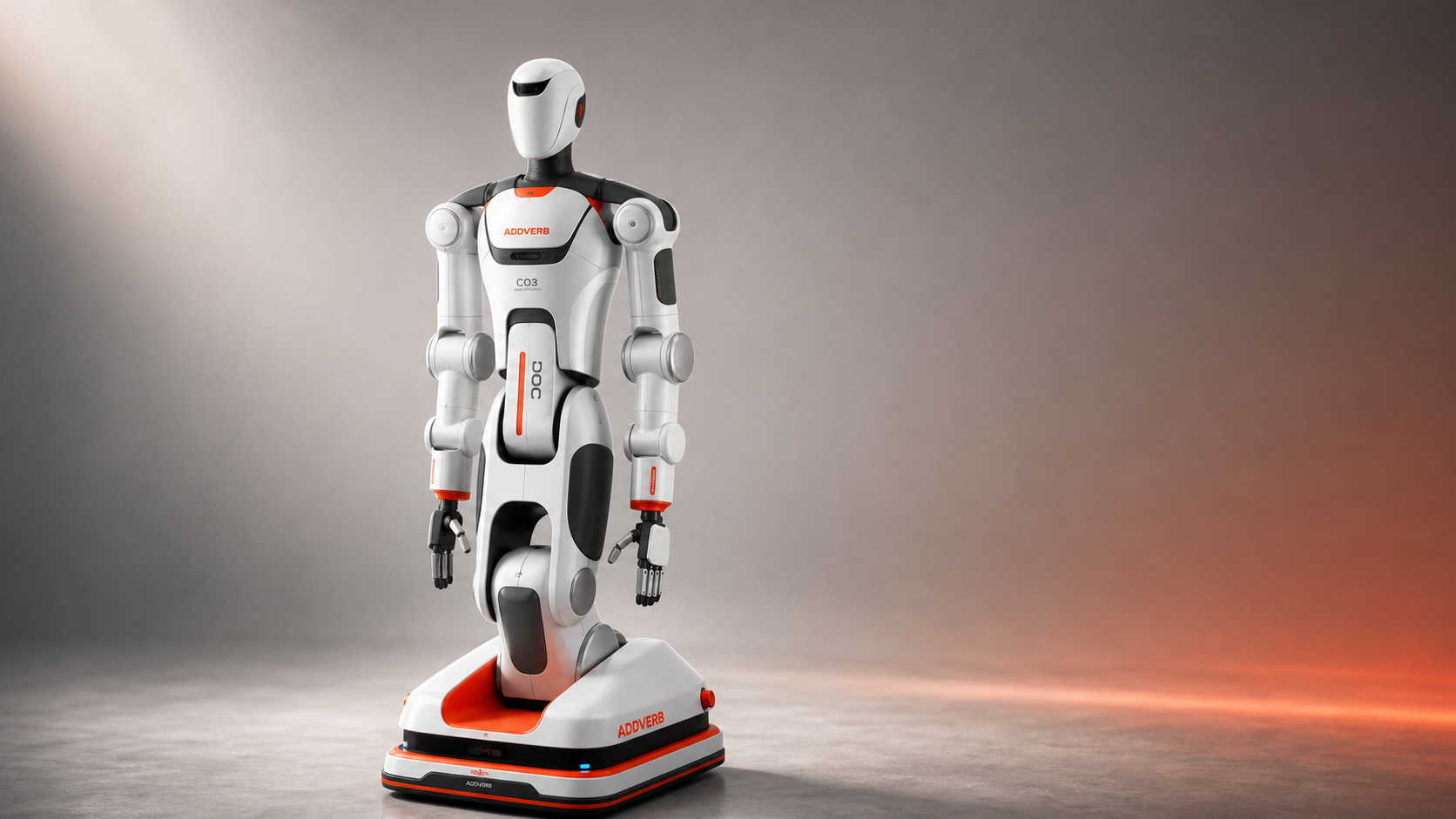
Addverb introduced Elixis-W at LogiMAT India 2026, extending its warehouse automation business into wheeled humanoid robotics. The launch puts Addverb on a practical industrial surface first: shop floors and warehouses where mapped routes, known workcells, charging routines, and integration software are already part of the operating environment.
Addverb was founded in India in 2016 and is led by co-founder and CEO Sangeet Kumar. The company says it has more than 350 global clients, 10 global offices, and more than 500 warehouses automated. Its product base already spans mobile robots, sortation, ASRS, picking systems, fleet management, warehouse execution software, and deployment services. Elixis-W comes from an automation supplier with customers and facility-integration history, not a humanoid-only lab program.
The Elixis product page separates the biped Elixis from Elixis-W, the wheeled humanoid variant for longer routes. Addverb lists Elixis-W with a 10 kilogram payload, speed up to 1.5 meters per second, roughly two hours of battery life, stereo depth cameras, 3D LiDAR, IMUs, NVIDIA Jetson compute, STM32 safety microcontrollers, and software combining 3D SLAM, navigation, reinforcement learning, imitation learning, model predictive control, and multimodal sensor fusion.
The wheeled design sharpens the industrial strategy. The biped platform gives Addverb a path into full humanoid locomotion, while the wheeled model keeps the first warehouse-facing version closer to current facility constraints. For many intralogistics tasks, human-like walking is less urgent than a robot that can move reliably through aisles and use hands around pallets, carts, racks, and conveyors.
Reliance gives the program a heavier industrial context. In 2022, Addverb said Reliance acquired a 54 percent stake for $132 million through a Series B round, valuing the company at about $270 million and supporting overseas expansion and manufacturing capacity in Noida. Addverb also said the companies planned to collaborate on 5G robotics, battery systems, and carbon-fiber structures.
The competitive field includes industrial humanoid developers, warehouse AMR providers, mobile manipulation startups, collaborative robot integrators, and established automation companies adding physical AI capabilities to warehouse workflows. Addverb?s distinction is the installed intralogistics layer: it can test wheeled humanoid capability against customers, software, and facility environments it already understands.
The proof boundary is still product-launch evidence. Addverb has disclosed the Elixis-W launch, platform specifications, and strategic fit with its warehouse automation business, but public material does not disclose named customer pilots, fleet size, pricing, uptime, production volume, task success rates, or customer-side economics for the humanoid line.
Elixis-W tests whether humanoid capability can enter industrial automation through wheels before legs. If Addverb converts its warehouse base into measured mobile-manipulation pilots, the company can position wheeled humanoids as an extension of facility automation rather than a separate robotics bet.
Have a robotics update Korthos should review? Send news, deployments, product releases, funding rounds, research, or media to tips@korthos.xyz or reach out on X at @agkorthos.