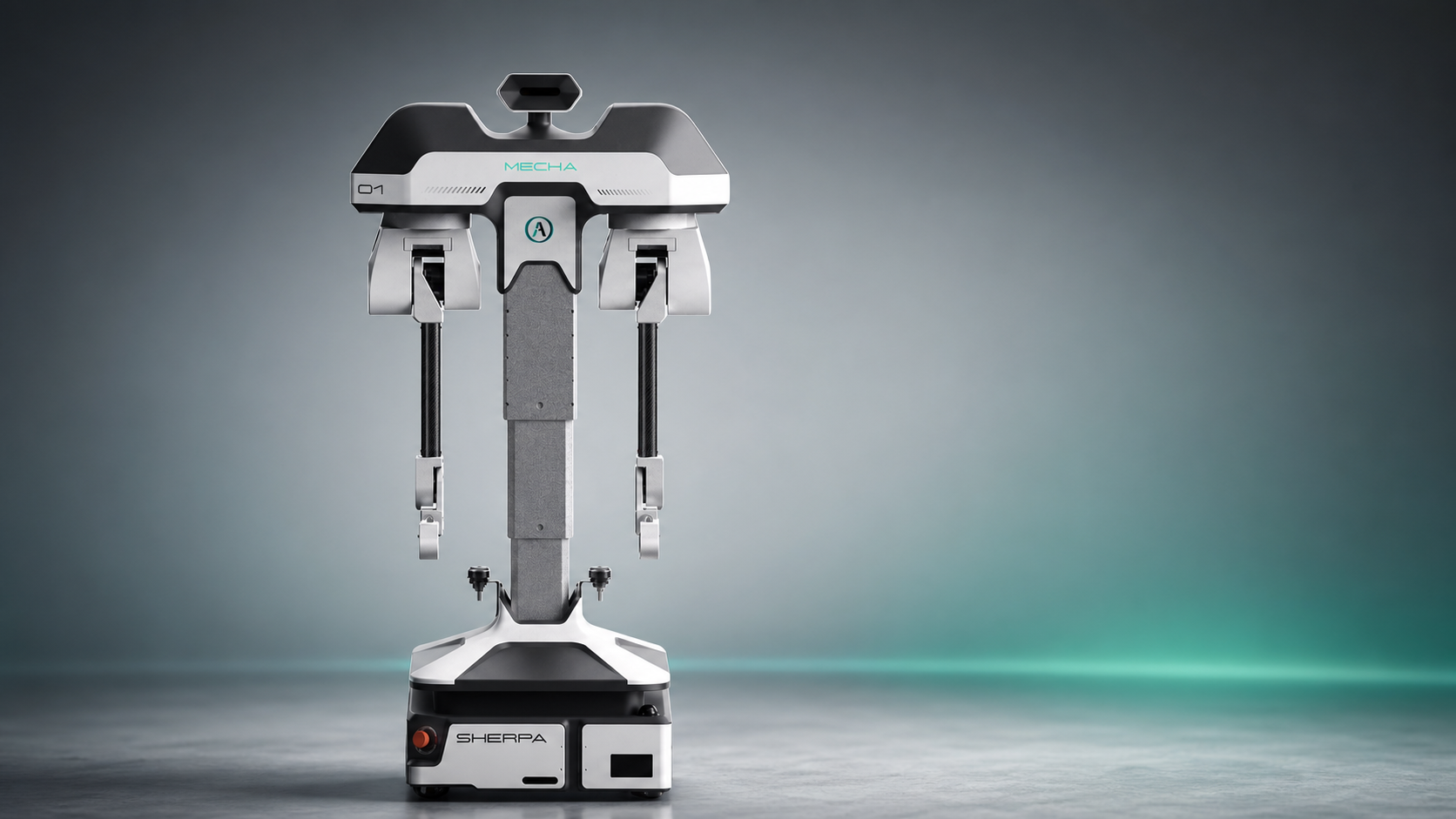
Ati Motors introduced Sherpa Mecha in October 2025 as a factory robot built around a wheeled base, two arms, and task examples including bin handling, machine tending, fastening, and tool changeouts. The launch broadens a company known for autonomous mobile robots into the work that begins after material reaches a station: picking, aligning, handling fixtures, and using tools inside production flow.
Ati was founded in Bengaluru in 2017 by Saurabh Chandra, a former Uber and Apple engineer, and has spent years selling Sherpa AMRs into factories and warehouses. Company material emphasizes manufacturing customers, fleet operations, and live industrial deployment, which gives Sherpa Mecha a stronger starting point than a robot launched without plant-level experience.
The product shift is significant. A transport AMR can be judged on routes, charging, dispatch, and obstruction handling. A mobile manipulator has to arrive at the right pose, understand the part or tool, apply force correctly, and recover when a bin, fixture, or machine is slightly different from the ideal case. Sherpa Mecha keeps the wheeled base because factories usually offer structured floors, while the arms add access to station-edge work still handled manually.
Ati entered the launch cycle with fresh capital. In January 2025, the company said it raised a $20 million Series B led by Walden Catalyst Ventures and NGP Capital to support global expansion of its AI-powered robotics workforce. Moving from AMR fleets into manipulation requires more field engineering, hardware iteration, and customer qualification than a routing-software upgrade.
The competitive field includes mobile manipulation systems from Robust.AI and others, humanoid factory entrants such as Figure and Apptronik, AMR vendors adding arms, and conventional industrial integrators building fixed machine-tending cells. Ati's distinction is the AMR base: existing navigation, mapping, safety, and plant service experience can help the company sell manipulation as an extension of factory mobility rather than a completely new automation category.
Public material does not yet show long-duration Sherpa Mecha deployments, cycle-time data, task success rates, failure recovery, station-level economics, or customer names for the new robot. The strategic test is whether Ati can turn its AMR relationships into mobile manipulation deployments that solve dull station work. If Sherpa Mecha proves reliable in a narrow set of factories, Ati moves from material transport into a broader factory labor layer.
Have a robotics update Korthos should review? Send news, deployments, product releases, funding rounds, research, or media to tips@korthos.xyz or reach out on X at @agkorthos.