
FieldAI is raising robotics autonomy around deployment surfaces
The Irvine company raised $405M for Field Foundation Models after deployments across construction, energy, manufacturing, logistics and inspection environments.
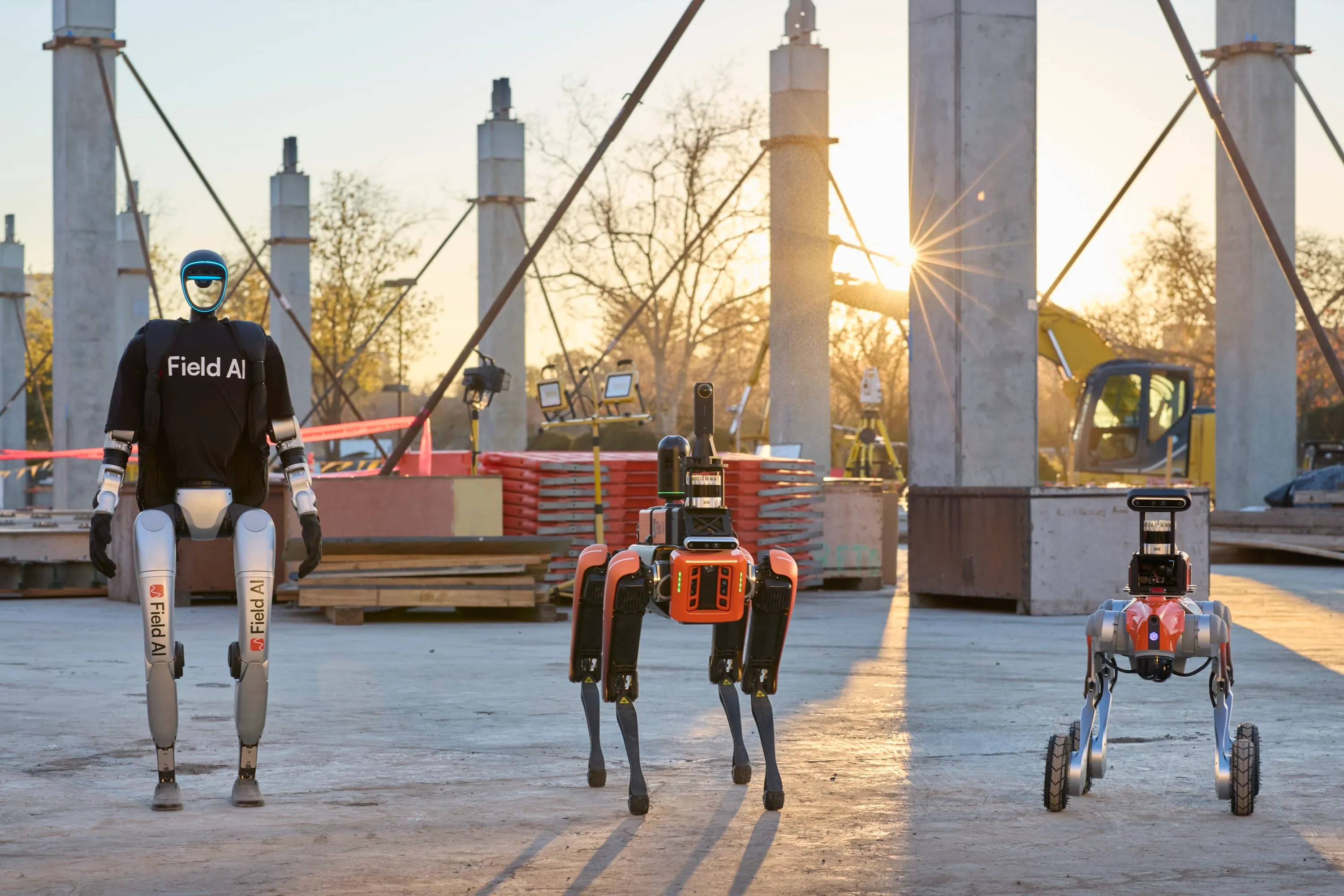
FieldAI raised $405 million across two consecutive rounds on August 20, 2025. Investors included Bezos Expeditions, BHP Ventures, Canaan Partners, Emerson Collective, Intel Capital, Khosla Ventures, NVentures, Prysm and Temasek, with Gates Frontier and Samsung listed as previous investors. CNBC reported a $2 billion valuation.
Team And Model
Ali Agha is founder and CEO. FieldAI is headquartered in Irvine, California, and its team includes robotics veterans from DeepMind, Google Brain, Tesla Autopilot, NASA JPL, SpaceX, Zoox, Cruise, Amazon, DARPA and Toyota Research Institute. Field Foundation Models are designed to run robot autonomy across different bodies and deployment environments.
FieldAI was founded in 2023. The company uses the term Field Foundation Models for robotics software that handles localization, planning, mapping and risk-aware behavior in changing physical environments. The model work is aimed at field robotics problems where routes, terrain, obstacles, lighting, dust, people and equipment can change between runs.
The technology page describes multimodal inputs including vision, LiDAR and text, plus model families for dynamics and multi-agent operation. FieldAI robots operate at the edge without maps, GPS or predefined paths. Applications listed on the site include mapping outdoor construction sites, scanning unfinished buildings, capturing industrial equipment readings and monitoring hazardous utility sites.
CNBC reported that FieldAI raised the $405 million through two rounds, with a $2 billion valuation after the recent raise. Axios reported the first $91 million at a $400 million pre-money valuation and the remainder at the $2 billion post-money mark. The investor list gives FieldAI financial backers across cloud, semiconductor, industrial, sovereign and family-office capital.
Deployment Surface
The funding announcement cited customer deployments in Japan, Europe and the United States across construction, energy, manufacturing, urban delivery and inspection. FieldAI said its systems had been tested and deployed across hundreds of complex real-world industrial environments. TechCrunch reported that the funding would support R&D, production ramp and international expansion.
The commercial surface is deliberately broad. Construction sites need mapping and progress monitoring across unfinished spaces. Energy and utility sites need inspection in hazardous or GPS-denied environments. Manufacturing and logistics sites need robots to operate around people, equipment, pallets, machinery and changing floor conditions. FieldAI is selling the autonomy layer into those conditions before committing the company to a single robot form factor.
FieldAI says FFMs have been proven across quadrupeds, humanoids, wheeled robots and passenger-scale vehicles. The public record names categories and geographies but does not name most customers, deployment counts, contract sizes, intervention rates, uptime, safety incident data or task-level productivity.
The analyst question is customer proof. FieldAI has disclosed capital, investor quality, model architecture, deployment categories and broad geography. The harder evidence will be named deployments with robot type, site type, task, duration, autonomy rate, failure modes and customer economics.
Have a robotics update Korthos should review? Send news, deployments, product releases, funding rounds, research, or media to tips@korthos.xyz or reach out on X at @agkorthos.
- Field AICompany