
Machina Labs is scaling robotic sheet forming into factory capacity
A $124M Series C funds a larger production footprint after Machina proved robotic sheet forming across aerospace, defense and mobility parts.
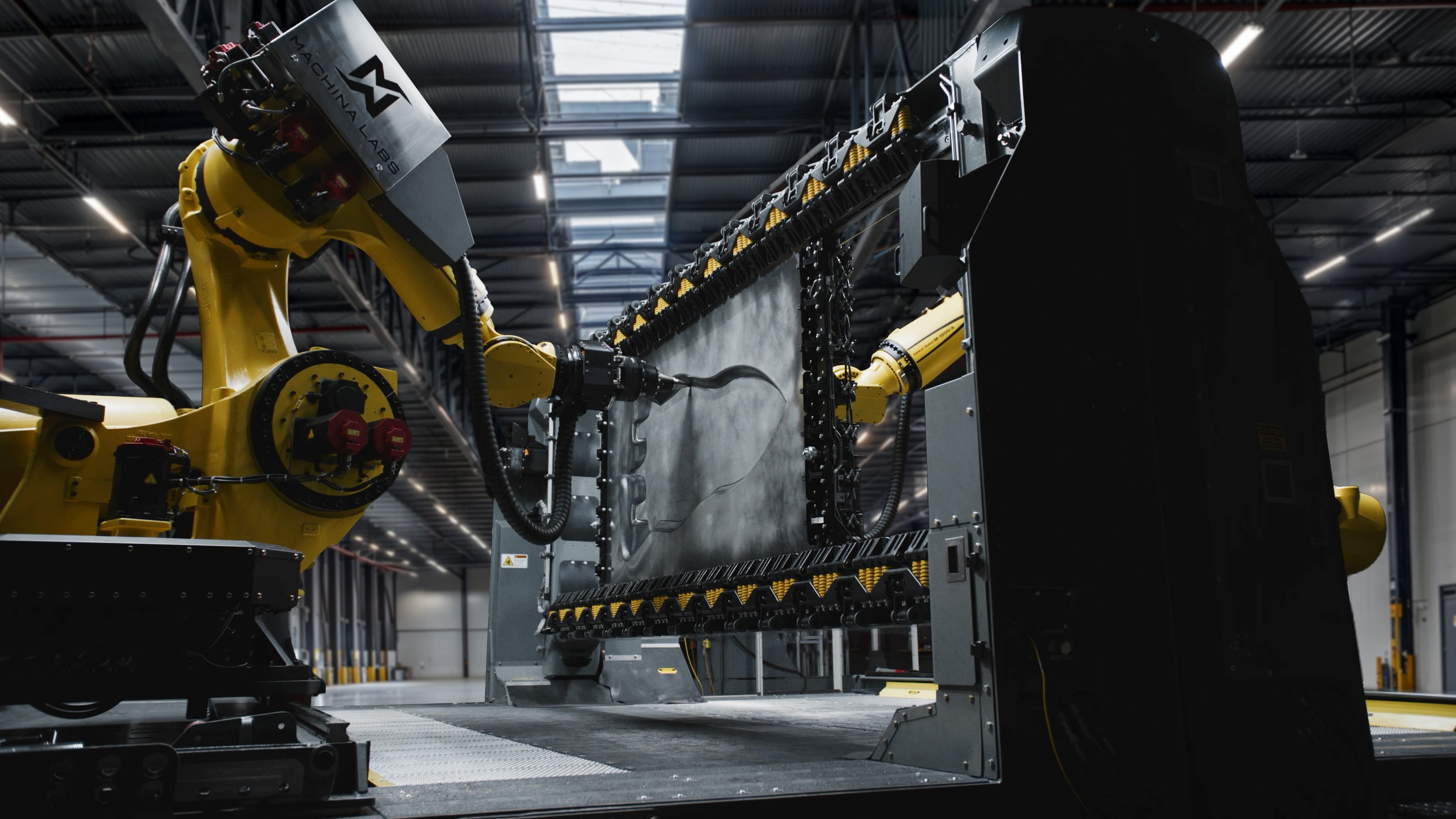
The factory plan changes the evidence bar. Robotic sheet forming is attractive for aerospace and defense because tooling can slow design change, low-volume production, and urgent manufacturing runs. Missile structures, airframes, and high-temperature alloys need repeatable process control, qualified materials, inspection traceability, and production yield. A larger factory means Machina has to prove the process can move beyond flexible prototyping into qualified output.
The investor mix also points toward the demand path. Lockheed Martin Ventures connects the company to defense aerospace, Woven Capital connects to mobility manufacturing, and Strategic Development Fund connects to EDGE Group in Abu Dhabi. Axios reported that Machina had worked with the Air Force and that the business mix was about 70% defense and 30% commercial at the time of the report.
The competitive field includes traditional tooling and stamping suppliers, aerospace fabrication shops, additive manufacturing companies, Hadrian, Divergent, automated composite and metal-forming systems, and defense primes building internal manufacturing capacity. Machina's distinction is flexible robotic sheet forming: using software and robot motion to reduce tooling dependence for metal parts that still need production-grade quality.
Public material still does not disclose production cadence, yield, machine utilization, qualified part volume, unit economics, or customer delivery metrics from the planned factory. The strategic question is whether robotic forming can become manufacturing capacity rather than a flexible prototype service. If Machina turns the new footprint into repeatable qualified parts for defense and aerospace customers, the company becomes a factory-capacity layer for programs that cannot wait for conventional tooling cycles.
Have a robotics update Korthos should review? Send news, deployments, product releases, funding rounds, research, or media to tips@korthos.xyz or reach out on X at @agkorthos.