Mirsee MH3 shows a Canadian route into industrial humanoid work
Mirsee Robotics is using MH3 to pursue a practical Canadian humanoid route: stable mobile manipulation, teleoperation and incremental autonomy for industrial sites with hard-to-staff work.
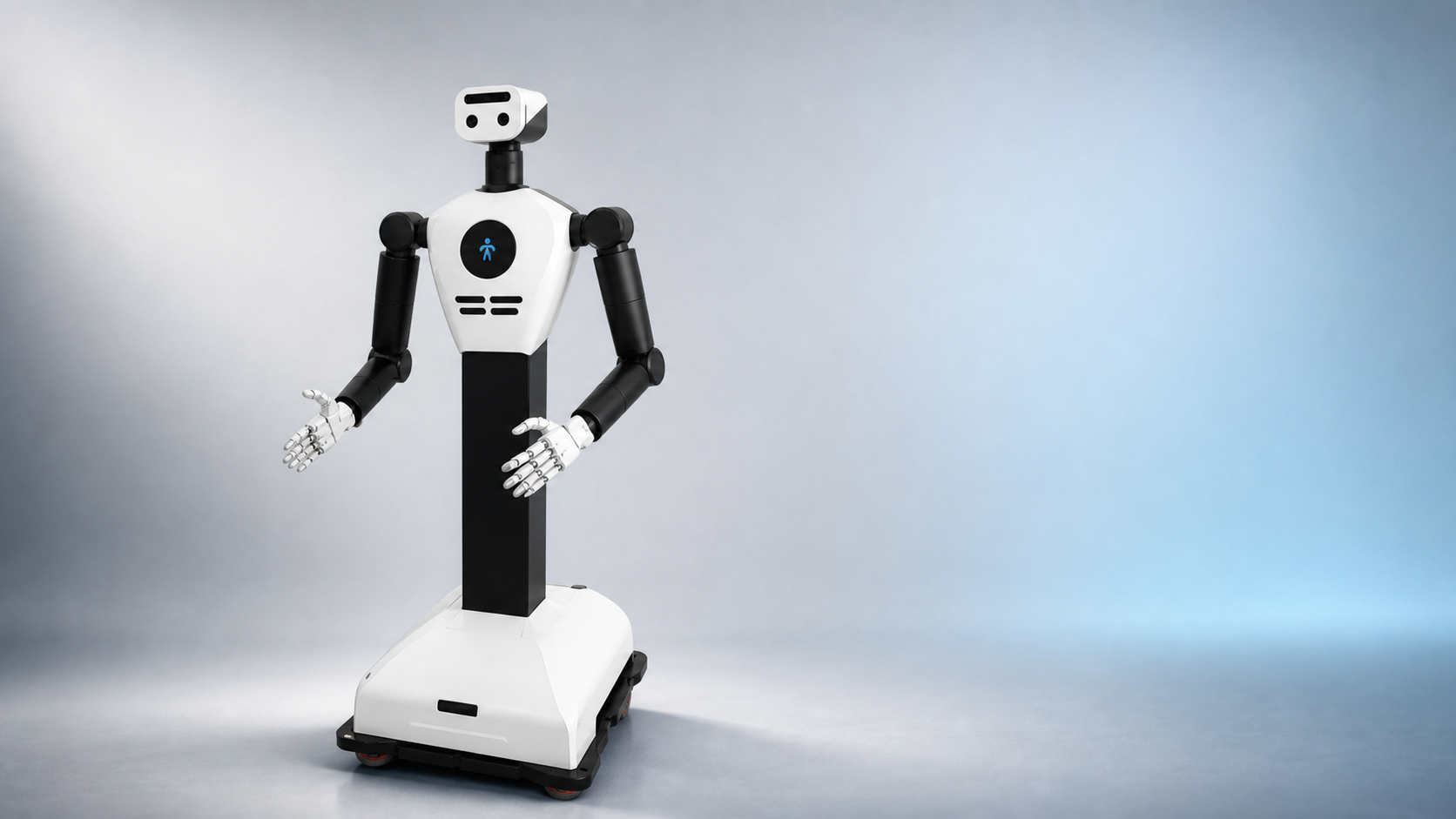
Mirsee Robotics has been moving through humanoid hardware in stages: MH1 in 2021, MH2 in 2023 and MH3 as its 2025 generation. The latest version keeps the company on a practical industrial path, with a mobile base, arms, hands, remote teleoperation, wireless charging, power-off brakes and a claimed ten-hour runtime. The sequence reads like an attempt to make supervised mobile manipulation deployable before autonomy carries the whole workload.
A Practical Industrial Shape
MH3 is built around a stable mobile base, arms, hands and a sensor head, which puts the robot closer to supervised mobile manipulation than full-body humanoid theater. That shape fits factories and distribution sites where movement happens on structured floors, payloads and tasks can be bounded, and operators can supervise difficult moments from a distance. Bipedal walking attracts attention, but a wheeled base can remove a large chunk of mechanical risk while preserving the humanoid pieces that matter for reaching into human-scale workspaces.
MH3 can be evaluated through customer workflow questions. A customer can ask whether the robot can move between stations, handle a specific object, recover from common errors, charge without special handling, and give a remote operator enough awareness to intervene safely. Those questions are still hard, but they lead to measurable pilots with visible task limits, intervention rates and operating conditions.
From MH1 To MH3
Mirsee lists MH1 with six hours of runtime, 28 degrees of freedom and remote teleoperation. MH2 added longer runtime, a heavier mobile base and hot-swappable batteries. MH3 adds more degrees of freedom, wireless charging and an AI-control layer. The public timeline points toward endurance, supportability and operator workflow, which are the pieces that decide whether an industrial robot survives beyond a trade-show booth.
The company also frames its systems as Canadian-built robots moving through phased deployment with strategic manufacturing partners. Public details remain thin: customer names, site counts, intervention rates, uptime, pricing and support economics still need evidence. Even so, the commercial posture has a clearer center than many early humanoid startups. Mirsee is pointing MH3 at labor shortages, hazardous or repetitive work, and structured industrial environments where a human-shaped upper body can be useful without asking the entire robot to behave like a person.
The Evidence To Watch
The next persuasive MH3 story would come from a narrow customer workflow, repeated enough to reveal the real operating model. A credible pilot would show the task, the objects, the route, the autonomy level, the remote-operator workload, the service interruptions and the reason MH3 performs better than a simpler mobile robot, fixed arm or custom automation cell. Those details would turn the robot from an interesting Canadian hardware program into a deployment case.
Canada gives Mirsee a useful contrast with the larger humanoid centers in the United States, China, Japan and parts of Europe. The country has deep robotics and automation talent, but fewer globally visible humanoid companies. A real MH3 deployment case would need to show the task, the route, the intervention rate, the service burden and the customer reason for using a supervised humanoid manipulator from Cambridge, Ontario.
Have a robotics update Korthos should review? Send news, deployments, product releases, funding rounds, research, or media to tips@korthos.xyz or reach out on X at @agkorthos.
- Mirsee RoboticsCompany
- MH3Product