
Cyngn is proving DriveMod Tugger with measured warehouse movement at U.S. Continental
U.S. Continental's DriveMod Tugger deployment gives Cyngn a measured material-handling case, replacing roughly 200 weekly forklift trips with an autonomous four-pallet transfer loop.
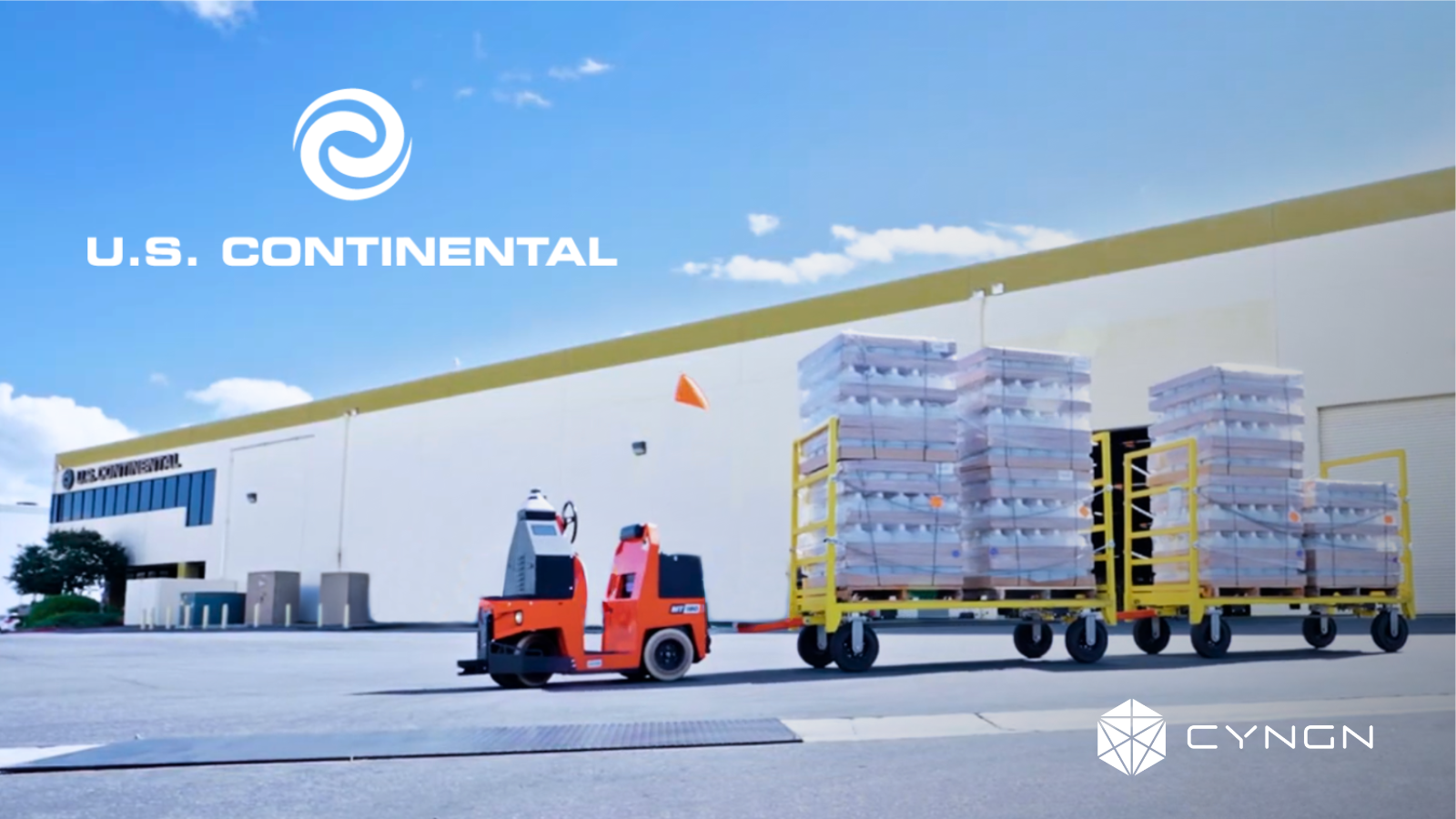
Cyngn's DriveMod Tugger deployment at U.S. Continental gives the company a cleaner proof story than a generic autonomous-vehicle announcement. The customer is named, the task is concrete, and the operating change is measurable. Before adopting DriveMod, U.S. Continental relied on roughly 200 forklift trips per week to move pallet deliveries between two buildings. Cyngn says that workload has been absorbed by the autonomous tugger.
The efficiency claim is simple: U.S. Continental reported a 4x increase in operational efficiency because the forklift moved one pallet at a time, while the tugger can move four pallets at once. The deployment also covers indoor and outdoor movement in clear, dry environments. Many plant-floor automation programs break down at the boundary between warehouse aisles, loading areas, and outdoor transfer paths, so the indoor-outdoor transfer loop is part of the proof surface.
The event positions DriveMod around repetitive industrial movement rather than consumer-road autonomy. Cyngn retrofits industrial vehicles with autonomous capability and wraps them with fleet management, teleoperations, and deployment support. Its DriveMod Tugger is built on the Motrec MT-160 and is described as hauling up to 12,000 pounds, operating inside and outside, and targeting a typical payback period of less than two years.
That places Cyngn in a crowded but commercially understandable field. It competes with manual forklifts and tuggers, AGVs, AMRs, autonomous forklift companies, and other retrofit autonomy providers. The difference in this case is workflow fit. U.S. Continental did not need a humanoid or a new warehouse architecture. It needed a repeated pallet-transfer loop to run with less manual effort, enough flexibility to move between buildings, and enough reliability to redeploy people into cycle counts, picking additional orders, and discrepancy follow-up.
The proof boundary is also clear. Cyngn has not disclosed the exact number of vehicles at U.S. Continental, uptime, incident record, achieved payback, or deployment cost. The 4x efficiency claim comes from the customer-side comparison of pallet movement method, not a full audited productivity study. But the public evidence is stronger than launch-stage positioning because it ties an autonomous industrial vehicle to a before-and-after workflow.
Cyngn's strategic path depends on finding more operations where autonomy can replace repetitive vehicle loops without demanding heavy infrastructure changes. U.S. Continental shows the shape of that wedge: a specific movement job, measurable trip reduction, customer-side efficiency language, and a material-handling vehicle that can operate across the facility boundary. If Cyngn can repeat that pattern across manufacturing and logistics sites, DriveMod becomes less of an autonomy platform pitch and more of a practical replacement layer for routine industrial transport.
Have a robotics update Korthos should review? Send news, deployments, product releases, funding rounds, research, or media to tips@korthos.xyz or reach out on X at @agkorthos.
- CyngnCompany
Track the machine economy
Regular Korthos briefings on robotics, drones, physical AI, supply chains, funding, product launches, and the companies shaping the stack.