
Vention is turning factory robot cells into a generalized physical AI pipeline
GRIIP packages scene digitization, segmentation, pose estimation, grasp selection, and collision-free planning for autonomous robot cells in unstructured manufacturing.
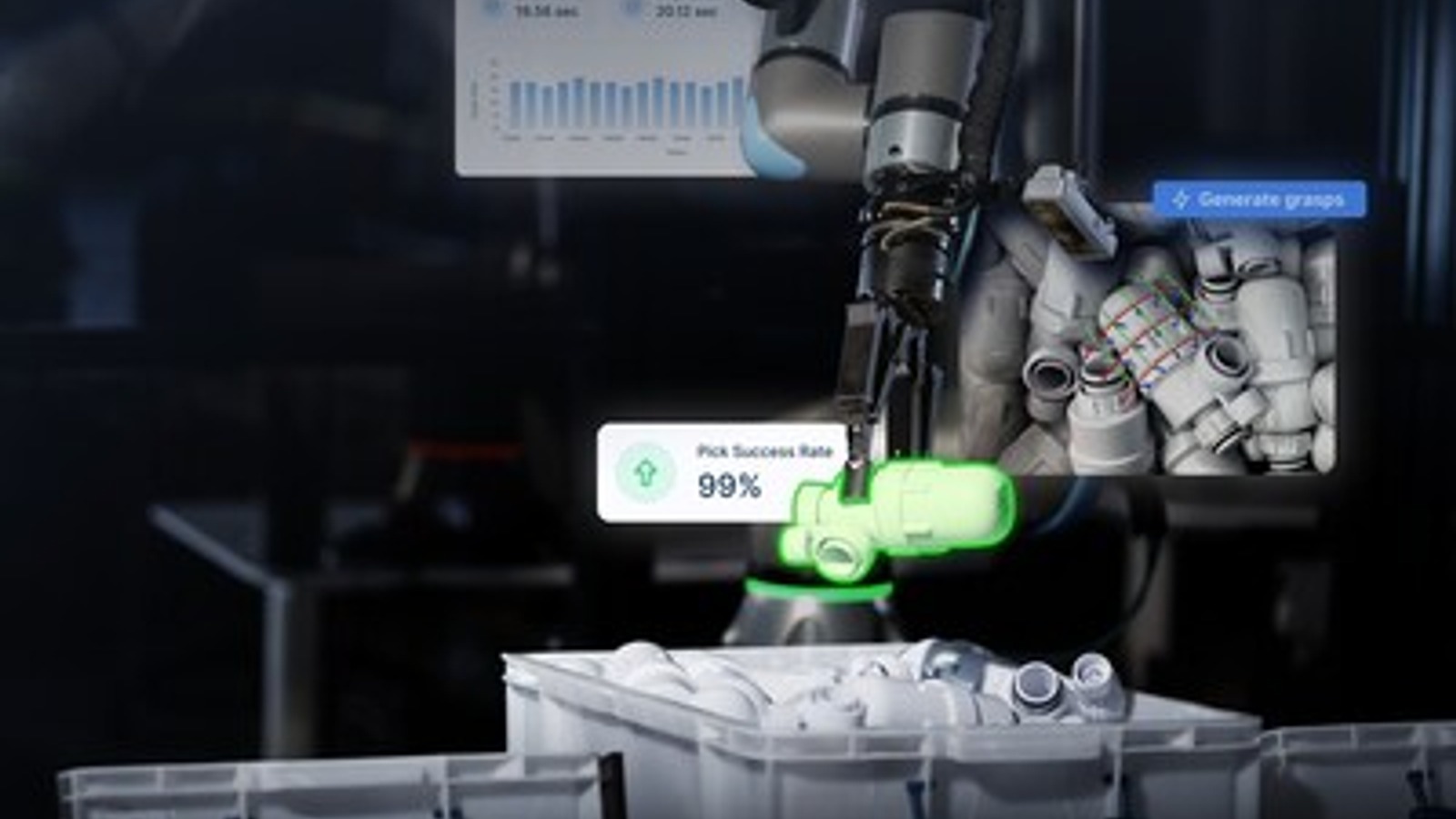
Vention announced GRIIP on February 10, 2026 as a generalized physical AI pipeline for autonomous robot cells in manufacturing. The company says the system spans scene digitization, object segmentation, pose estimation, grasp selection, and collision-free motion planning, with NVIDIA Isaac models used inside the architecture.
Vention was founded in 2016 in Montreal and built its business around modular factory automation: design software, machine components, controls, deployment support, and a marketplace-like approach to building automated systems. Its earlier Interpack 2026 packaging launch positioned the company around faster end-of-line automation. GRIIP is a different event: it pushes Vention deeper into adaptive robot intelligence for unstructured manufacturing tasks.
The manufacturing problem is that many robot cells still work best when the parts, fixtures, and process stay predictable. High-mix production breaks that assumption. A bin of randomly oriented metal or plastic parts can vary by shape, surface texture, colour, lighting, and occlusion. A traditional cell may need custom programming, fixtures, part-specific training, and commissioning work before it becomes stable enough for production.
GRIIP is Vention's answer to that variability. The company says the pipeline supports bin picking, machine tending, kitting, and other applications without task-specific programming. It also claims CAD-to-pick setup in 15 minutes, full robot-cell deployment in under two days, and autonomous 24/7 lights-out production over three months at up to five parts per minute. Those are company-reported results, not independent site metrics, but they give the launch a clearer performance surface than a software roadmap alone.
The technical story is not only perception. GRIIP connects recognition, pose estimation, grasp planning, and motion planning into one workflow so the cell can move from seeing a part to deciding how to pick it and reaching it safely. Vention says the system combines proprietary models with NVIDIA FoundationStereo for stereo matching and FoundationPose for pose estimation, turning the cell into a continuously improving software pipeline rather than a fixed automation recipe.
The competitive field includes Covariant-style warehouse manipulation AI, GrayMatter Robotics for process-specific robotic workcells, FANUC and Intrinsic-style software layers around industrial arms, RobCo-style deployable factory automation, Wandelbots-style robot programming, and internal AI automation stacks built by large manufacturers. Vention's distinction is its existing modular deployment platform: if GRIIP works, the intelligence layer can be packaged with the hardware, controls, and deployment workflow instead of sold as a standalone model.
GRIIP positions Vention around a broader question in factory automation: whether robot cells can become configurable products instead of custom engineering projects. If the company can make generalized perception and grasping reliable across more parts and workcells, Vention moves from modular machine builder toward an operating layer for manufacturers that need automation to adapt as production changes.
Have a robotics update Korthos should review? Send news, deployments, product releases, funding rounds, research, or media to tips@korthos.xyz or reach out on X at @agkorthos.
- VentionCompany
Track the machine economy
Regular Korthos briefings on robotics, drones, physical AI, supply chains, funding, product launches, and the companies shaping the stack.