
Addverb introduces Elixis-W for industrial humanoid work
Elixis-W extends Addverb from warehouse automation into wheeled humanoid robotics, where its installed automation base gives the company a clearer path to industrial pilots.
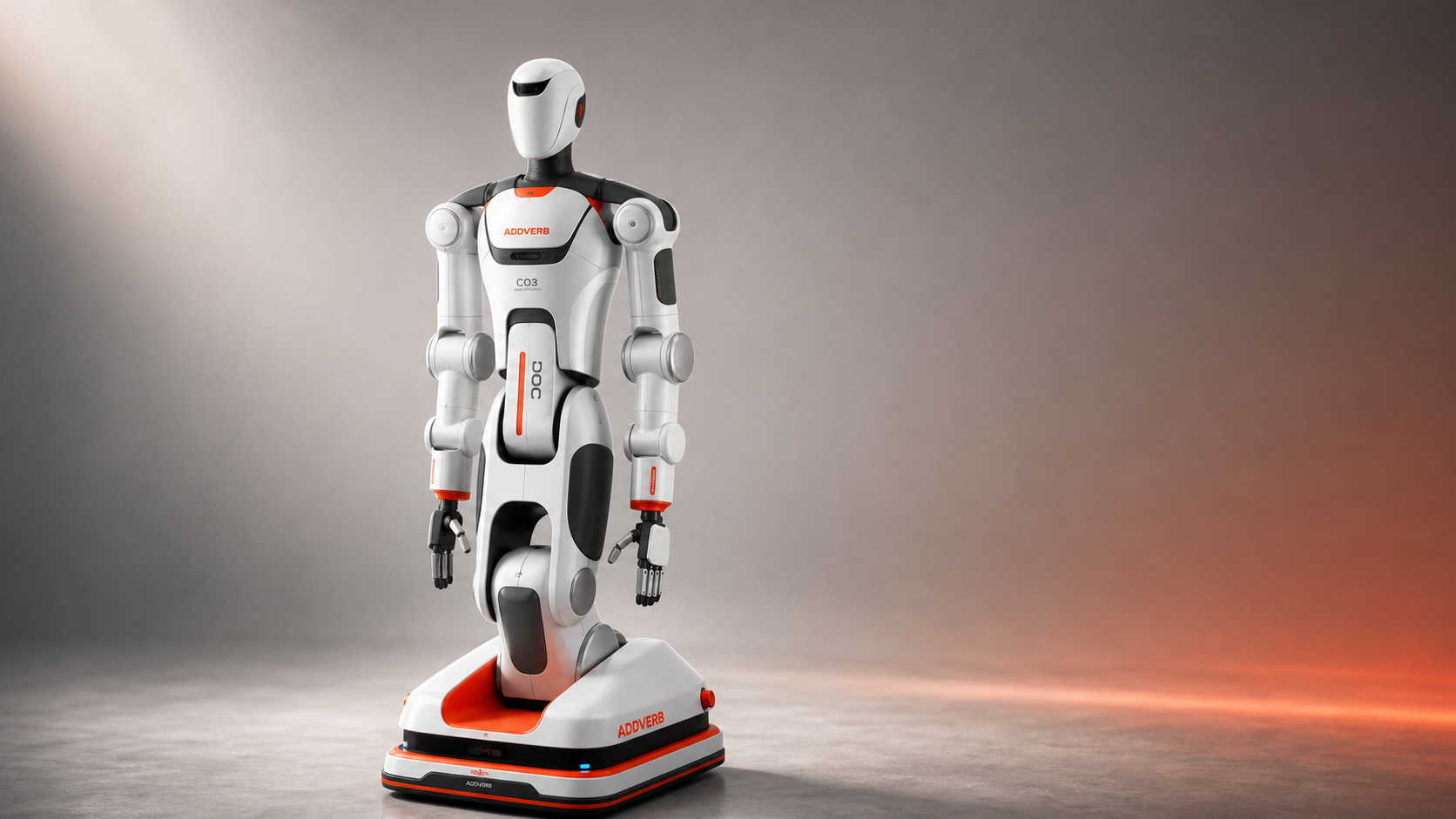
Addverb introduced Elixis-W at LogiMAT India 2026, extending a warehouse automation company into wheeled humanoid robotics. The robot is aimed at industrial sites where Addverb already understands material movement, warehouse layouts and customer integration, giving the humanoid program a starting point inside existing operations before broader legged systems enter the roadmap.
The Company
Addverb was founded in 2016 and says it now has more than 350 global clients, 10 global offices and more than 500 warehouses automated. The company is not starting from a lab demo or a software model alone. It already sells mobile robots, ASRS systems, picking systems, sortation, warehouse software and deployment services into the kinds of buildings where a wheeled manipulator could be tested against known workflows.
Addverb has been widening its robot portfolio around several forms of industrial mobility. Trakr covers quadruped inspection, Elixis gives the company a biped humanoid path, and Elixis-W keeps the industrial version on a mobile base. The portfolio puts three forms around one deployment question. Industrial customers may need different mixes of legs, wheels, hands and perception depending on the site, task and tolerance for integration work.
Reliance gave that expansion a heavier industrial backer. Addverb said Reliance acquired a 54 percent stake for $132 million in a Series B round, with plans to collaborate on 5G robotics, battery systems and carbon-fiber structures. Elixis-W is being built by a company with automation customers, manufacturing ambition and a strategic investor tied to large retail, distribution and industrial environments.
Elixis-W
The Elixis product page separates the biped Elixis from the wheeled Elixis-W. Addverb lists Elixis-W with a 10 kg payload, up to 1.5 m/s speed and roughly two hours of battery life, while the broader platform uses five-finger or parallel-jaw end effectors, stereo depth cameras, 3D LiDAR, IMUs, dual encoders, NVIDIA compute and a control stack combining reinforcement learning, imitation learning and MPC.
The split between Elixis and Elixis-W is the more useful product signal. The biped gives Addverb a full humanoid platform for longer-range physical AI development. The wheeled model keeps the first industrial version closer to warehouse reality, with flat floors, mapped routes, known workcells, predictable charging, and tasks where hands and perception can matter more than human-like walking.
Elixis-W can be discussed as an industrial humanoid, but its strongest near-term case is mobile manipulation in environments where Addverb already has relationships, integration knowledge and software infrastructure. The robot still needs customer-side evidence. Addverb at least has a route to that evidence through customers already using automation in warehouses and industrial sites.
Maturity
Addverb has disclosed the product family, launch setting and public specifications. Customer-side Elixis-W deployments, fleet size, pricing, operating uptime and production volume have not been published. The clearest proof will come from named humanoid pilots where the robot performs measurable work in live industrial environments, especially if Addverb can connect Elixis-W to warehouse customers already using its automation stack.
Have a robotics update Korthos should review? Send news, deployments, product releases, funding rounds, research, or media to tips@korthos.xyz or reach out on X at @agkorthos.
- Addverb Technologies Private LimitedCompany
- Elixis-WProduct
- ElixisProduct