Vention is packaging end-of-line automation around Universal Robots cobots
The Interpack 2026 launch turns Vention's modular hardware and software into a full packaging-line offer with Universal Robots.
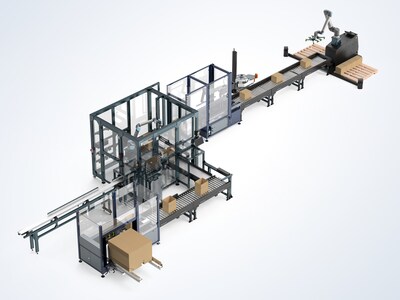
Vention introduced an end-of-line packaging automation portfolio at Interpack 2026 on May 7, showing robotic case packing, modular conveying, cobot palletizing, and industrial palletizing alongside Universal Robots. The release positions the launch as a single packaging-line environment rather than a set of separate cells.
Vention is a Montreal-based industrial automation platform company founded in 2016 by Etienne Lacroix and Max Windisch. The company combines modular hardware, software, controls, and remote support, and has raised major growth financing, including a $95 million Series C in 2022 led by Georgian and Fidelity. Its existing public profile already includes more than 25,000 deployed machines and a community of more than 4,000 factories. Universal Robots brings the cobot layer, including UR10e and UR20 systems used in the Interpack demonstrations.
The packaging problem is integration speed. Manufacturers often automate end-of-line work one piece at a time: a case-packing cell, a conveyor segment, a palletizer, then the control logic and maintenance process to hold it together. That can work for stable high-volume lines, but it is slow and costly for high-mix manufacturers that need to change case formats, pallet patterns, line layouts, and product flow.
Vention's Interpack portfolio runs on MachineMotion AI controllers and MachineLogic programming software. The system includes MachineAnalytics, RemoteView streaming, remote support, Wi-Fi, LAN, and LTE connectivity. The conveyor ecosystem uses modular O-Ring and Poly-V conveyors, Vention-designed motors, plug-and-play controls, EtherCAT communication, and software tools for synchronized flow and zero-pressure accumulation.
The launch also makes specific deployment claims. Vention says its third-generation Rapid Series Palletizer can be deployed in as little as four weeks, while complete end-of-line systems including conveyors, case packing, and palletizing can be delivered in 12 weeks. The company also says installation and ramp-up can be reduced to one to three days in some cases, and cites payback periods as short as 1.3 years and up to 25% lower capital costs compared with traditional automation.
The competitive field includes traditional packaging integrators, palletizer vendors, cobot palletizing specialists, conveyor suppliers, and full-line automation providers such as Rockwell, Siemens-integrator ecosystems, FlexLink-style conveyor platforms, Robotiq-type cobot tooling, and UR-based cell builders. Vention's distinction is the common platform layer: design, controls, operator interface, analytics, and remote support packaged around modular hardware.
The Universal Robots collaboration positions Vention around faster packaging automation for manufacturers that want cobots and modular equipment without a long custom integration project. If the platform keeps reducing commissioning and maintenance complexity, Vention becomes less of a machine builder and more of an operating layer for end-of-line automation.
Have a robotics update Korthos should review? Send news, deployments, product releases, funding rounds, research, or media to tips@korthos.xyz or reach out on X at @agkorthos.
- VentionCompany
- Universal RobotsCompany
Track the machine economy
Regular Korthos briefings on robotics, drones, physical AI, supply chains, funding, product launches, and the companies shaping the stack.